When I arrived at WMATA's IT/Digital Modernization division, internal communication ran through a single channel: the newsletter. It carried everything. Strategic updates. Team news. And the outage and maintenance notices that frontline employees needed in real time. Engagement sat at 17%. I rebuilt the publication itself. That work is its own case study. But the structural problem remained. Viva Engage is the second channel I built to fix it.
The diagnosisOne channel doing two jobs that worked against each other
The newsletter was being asked to do incompatible work. A periodic publication is the right vehicle for storytelling and reflection. It is the wrong vehicle for time-sensitive operational information. If a system goes down, people need to know within minutes, not in the next edition.
The result was predictable. People stopped opening the newsletter because most of it didn't apply to them in the moment. And critical operational information landed too slowly to act on. Both jobs were being done badly because they were sharing the same pipe.
Step oneResearch, pilot, deploy a second channel
I researched, piloted, and deployed Viva Engage as the operational channel: fast, conversational, designed for short bursts of information. The newsletter stayed put for longer-form storytelling. Two channels, two jobs, no more conflict.
The first content on Viva Engage was deliberately low-stakes: office productivity tips. Useful, not critical. Engagement ticked up. People started checking the platform because what was on it was worth their time.
Then I moved the outage and maintenance updates over. Engagement rose again, because now the platform carried something people actively needed to see. By the time critical content lived there, the audience was already in the habit of looking.
Step twoTreat the platform the way users already treat platforms
This is where the engagement numbers actually moved.
I rebuilt the editorial model around three rules drawn from social media, not from corporate communication:
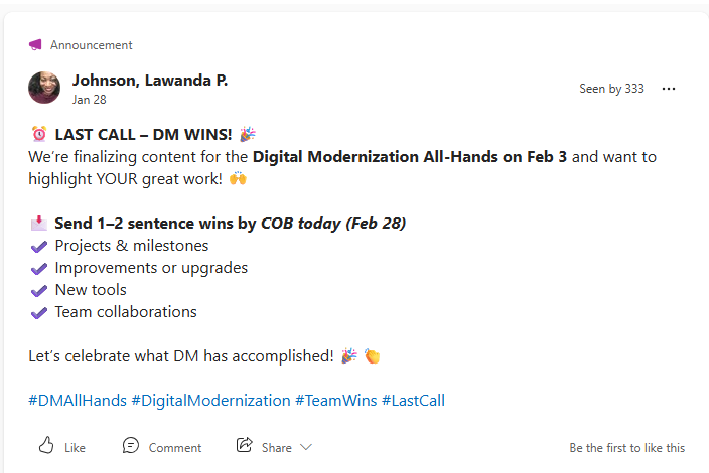
Short and scannable. Posts had to be readable in under ten seconds on a phone screen. Body copy got cut hard. Emoji-driven visual hierarchy replaced long paragraphs.
Two-way, not broadcast. Every post asked for something. A contribution. A comment. A reaction. The post below is typical: instead of announcing an upcoming All-Hands, I used Viva Engage to source the celebration content from the team itself. People came to the meeting invested because they had helped build it.
Rhythm over polish. Consistent cadence beat occasional heroics. People started looking for the next post.
The signal that matteredOther communicators came to me
Engagement numbers are useful but easy to discount. The signal I trust more came from outside Digital Modernization.
The agency's Director of Employee Communications asked me to help her drive engagement on compliance-sensitive issues, including staff use of personal email accounts. Other departments came to me to help build their own Viva Engage presence and coach their teams on how to use it. The short, scannable, visual posts model became an informal standard across the agency, not because anyone mandated it, but because people watched it work.
That is the outcome I am proudest of. The engagement numbers prove the model worked. The fact that the people whose job was internal communications recognized me as the expert proves the model was repeatable.